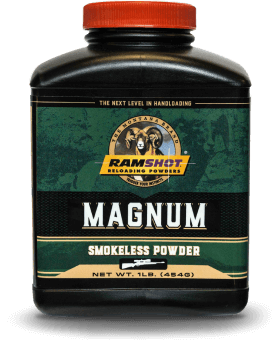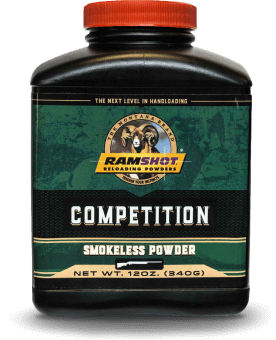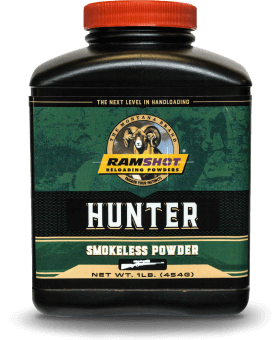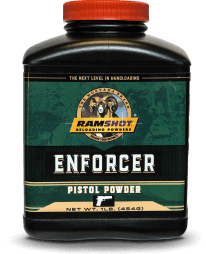


From the serious competition marksman to the recreational shooter, Ramshot offers a full range of smokeless powders that consistently meet the high standards of all shooting enthusiasts.

Multiple sites are now impersonating the Hodgdon Powder Company or our brands like Hodgdon, IMR, Winchester Smokeless Propellants, Accurate Powder or Ramshot.


A double-base, clean burning, high performance propellant that is perfect for elk country cartridges such as the 270 Winchester, 300 WSM and 338 Win Mag. It’s the only spherical powder in the popular 4350 burn range making it an ideal powder for a wide range of cartridges. The excellent flow characteristics allow accurate metering and consistent shot-to-shot results. Made in Belgium.
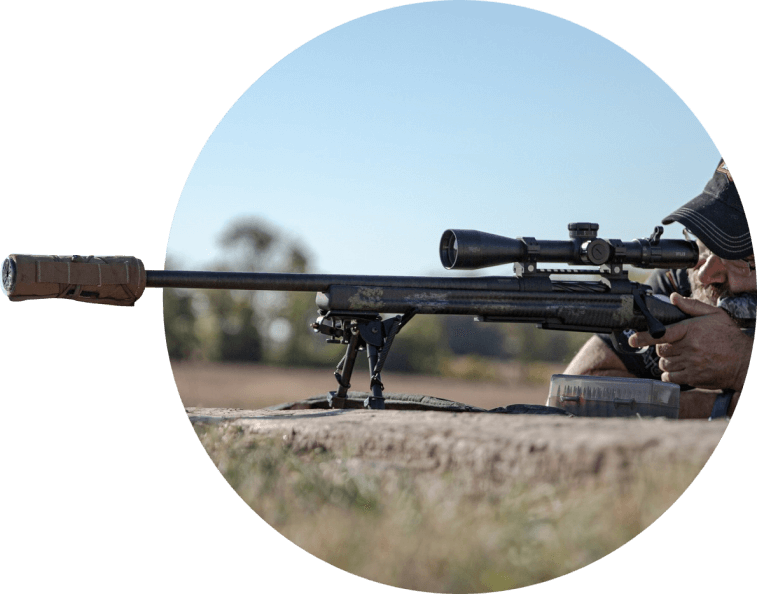
To maximize performance, the ballistics experts at Hodgdon Powder Co., Inc. have developed a comprehensive Reloading Guide to provide handloaders with current data for Accurate Powders. To view the reloading information in PDF format, click the boxes or links below.


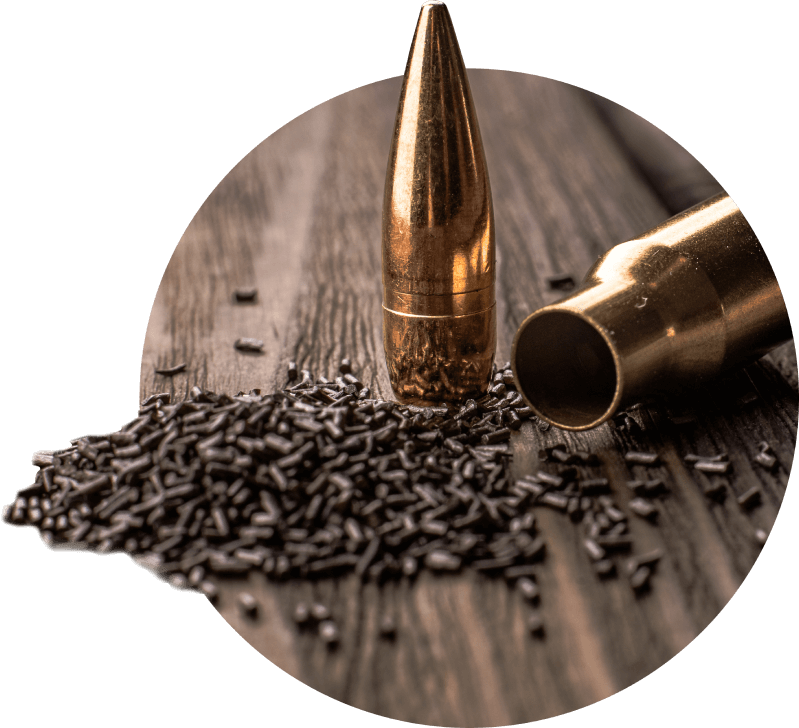
For your reference, we offer a comprehensive list of Relative Burn Rates* for all gun powders. This list is sorted from the powders with the fastest burn rates to those with the slowest burn rates. To view this list in a PDF format, click the button below.
Maximize your precision and stay accurate with warnings, safety data sheets and current reference data.

Intended for reference use. Each individual hand loader must determine what is the best and safest load for their equipment.
Use these products only in strict accordance with loading instructions provided.
Ammunition hand loading has become increasingly popular in recent years. This section discusses properties of smokeless powder and offers recommendations for its storage.
Special warning concerning chamber dimensions of semi auto handguns that do not fully support the case.
The GOLDEN RULE of reloading is to always to begin at the recommended START load, which is between -10% below the MAXIMUM load for most Rifle calibers and up to 15% below for certain handgun calibers.
The 1st and foremost reason is SAFETY:
Due to a myriad of variables that can exist and which is totally outside the control of the institution which generates the reloading data, it is imperative to consider the safety aspect and begin at a properly reduced low energy level.
The 2nd Important reason is OPTIMIZING for ACCURACY:
The ability to induce a wide range of energy levels, will improve the ability to “find” the optimal “sweet spot” and the smallest possible group for a particular weapon system/platform, and component combination, i.e. primer, case, powder and bullet.
All the testing is done in test barrels according to primarily to SAAMI and in some cases the CIP specifications (International protocol).
Whenever, it is possible to measure a parameter accurately, it is a huge advantage to know/conclude what is happening. It will immediately tell you whether the combination is in-line with the published reloading data or not. The availability of affordable and accurate chronometers has put this measuring ability within reach of most reloaders today.
Most of our powders are not insensitive, and will show some effect at hot and cold temperatures.
However, we test at -40F and +125F and the deviation in most cases are ca 3% to 5% at these extreme levels. Therefore most shooters do not notice much difference under normal practical hunting conditions.
More elaboration on the subject:
Complete temperature stability can only be achieved with tubular extruded powders designs, either with double base (NG) and/or with other coating technologies.
Because the ballistic performance at extreme temperature is completely dependant on the specific combination, it is very difficult to quantify and qualify.
Our standard powders perform very well at extreme temperatures, and usually pass the strict military requirements by a large margin.
This is a subject that often fraught with misconceptions and inaccuracies.
The term is used loosely by manufacturers without qualifying the subject, and is obviously exploited for marketing purposes and perceptions.
The facts are:
If any of these parameters/aspects go beyond or outside the intended ratio/s, the results will change and the performance will sometimes be different.
It is also very important that when a comparison is made, that all conditions re weapon i.e. components primer, case, bullet and the velocity are equal, and preferably done at the same time on the same day.
Accuracy is totally dependant on the specific combination, and is therefore impossible to predict.
The dispersion of the bullet is largely determined by the stability of A) the launch platform/system, which off course includes the shooter, as well as B) The external ballistics of the bullet in flight. The launch platform stability is controlled, and determined, by a complex interaction of the different components primer case bullet and gun (as well as shooter) none of which can be considered “accurate” as a separate entity.
It’s is not correct, and a common misconception, to assume that there are so called “accurate- powders, primers, cases, projectiles etc. Any one of these claims can be easily disproved with a different combination. It is true that some weapons are inherently unstable and no matter of combination will reliably deliver acceptable accuracy.
These components aspects/parameters all contribute to the “launch-impulse”, and performance level (velocity and pressure). The dynamic characteristics of this impulse are therefore very specific for each combination. How the launch platform/Rifle reacts to this impulse, determines the launch stability, and as a result the accuracy/dispersion. This specific reaction of the launch platform can be described the “dynamic character or -finger print” of the weapon/ammunition system. That’s why an “accurate load/combination” can only be achieved through incremental adjustments, and/or variations of these different components, and parameters.
The only way to properly do this is, to always start at the minimum or start load, and work up towards the maximum suggested load, with the components at one’s disposal. If the desired accuracy is not achieved, the second phase will be to adjust or change the components, i.e. primer, case, case condition, projectile/bullet or the type of powder altogether. The important thing to remember is to change/vary only one parameter/component at a time.
We refrain from predicting accuracy. Although some people, and institutions, recommend so-called “accurate loads” and combinations it’s not very well founded or scientific because, the assumption is made that all systems and conditions are equal, which is not true.
Because some internal barrel profiles (Mostly for handgun calibers), such as the polygon® and hexagonal® have unconventional “smooth” internal dimensions, its inevitable that the diameters of these barrels be extremely tight, to engage the bullet in order to impart the rotational forces for stability. When cast bullets are used in conjunction with these barrels, it imperative that the dimensions should be sized correctly, and that the hardness be such as not to cause any lead fouling. Any build-up or deposit of bullet material in the forcing cone freebore/lead area might result in a high pressure and the resultant damage to the weapon and/or injury to the shooter.
It depends on the specific composition of the powder itself, and also the geometry. Modern smokeless powders can be divided into two main groups.
Single base:
Geometry: Extruded Flake/Disc or tubular.
Double base:
Geometry: Ball/spherical or extruded flake/disc or tubular.
Single base powders:
Single base powders are more hygroscopic than double base.
Since the vast majority of this powder consists of just NC Nitro Cellulose, and does not contain other ingredients which will seal the powder composition, it will be more porous, especially some of the extruded flake/disc powders aimed at shotgun or handgun applications.
Double base Powders:
When Nitroglycerin is added, the product is gelatinized or plasticized which will result in the grains being less porous and “sealed” against external atmospheric conditions.
Geometry:
If the individual granules are extremely small the chances of it sticking/clinging to synthetic materials are more possible.
Even double base ballpowders, such as in the case of extremely fast burning ballpowders for Shotgun/handgun applications, which can also be sometimes rolled/flattened, will also tend to cling to the sides of synthetic (static) containers/hoppers.(see question below re static elecricity)
Flash suppressant;
Another component that will casue powders to be more hygroscopic is when flash suppressants, which is basically salts, are part of the composition.
It will also therefore depends on if, and what percentage of flash suppressant is present in specific powder.
In general we can state that:
There are a few things one can do to alleviate or eliminate static electricity.
A) Add a very fine grained “lab grade” graphite powder to the powder, at about 1 teaspoon per lb and shake very well.
This is usually available at hardware stores in the lock/key departments or from laboratory equipment/material suppliers.
This graphite can also be rubbed into/onto surfaces in contact with the powder.
Caution: This powder is extremely fine and will be difficult to get of skin so we strongly suggest using surgical gloves when handling the graphite. Also take care not to spill it on clothes because will be hard to clean. Hard to reach places can be treated with cotton swabs dipped in the graphite powder.
Another option is to rub the inside surfaces of hoppers with antistatic cloths used in cloth dryers.
A third will be to earth/ground the loading equipment. Also be aware of the Relative Humidity of the loading area. The ideal is to keep the RH between 50 and 70%. If the RH goes very low the static will become more pronounced and it might be good to invest in a humidifier. The RH must be monitored with an accurate instruments or a wet and dry ball thermometer unit (which is the most accurate).
The most critical dimensions are those immediately beyond the chamber/case mouth, known as the “Freebore” and “Leade”. This is where the engraving process takes place, which determines the level of resistance which in turn “controls” the combustion process.
This is also the area that experiences the highest and most severe forces and or conditions i.e. Peak-Acceleration, Peak- Pressure and Peak-Temperatures, therefore its also the area that experiences the most erosion and wear which ultimately leads to reduced velocities of a typical worn barrel.
Any change in these dimensions can have significant and sometimes dramatic effects. If the dimensions are tight and short the pressure can rise significantly and the inverse happens when these dimensions are large/long or “loose”.
This also depends on the caliber design and its expansion ratio. If it’s a high expansion ratio caliber such as the 458WinMag 444Marlin etc the effects will be less than that of a low expansion ratio caliber also known as an “overbore” calibers such as the 264WinMag 7mmRem Mag etc. The standard calibers will fall somewhere in-between.
There is unfortunately no simple solution or recommendation, because the primers of different manufacturers can differ quite substantially even when rated for the same category.
However, as far as safety is concerned for the most general and popular calibers standard primers of most manufacturers will work in both the handgun and rifle categories.
The belief that all spherical powders must be combined with magnum primers is not true. This might have been the case in the early years. However, what is suggested is that as soon as the capacity of a typical rifle caliber goes beyond 70 grains it will be good to use a higher energy “Magnum” rated primer. In the case of handguns its more difficult and as far as our Accurate products is concerned it will be good to use magnum primers when the Chargemass exceeds 20grains in a typical bigger bore caliber such as 44 and larger.
As far as accuracy is concerned, which depends on the intricate/complex interactions of the components and weapon system/platform a change in any one of the major components including primers can have a significant effect, for better or worse. Therefore it will be wise to experiment with different primers if a problematic situation arises.
Not always, and unfortunately it’s hard to predict and quantify. It depends on the combination of powder-caliber-pressure/performance level. However, in most cases the difference is small especially in the case of rifle calibers. In the case of handgun caliber certain magnum primers can cause higher pressures, however this is more the exception than the rule. Also the number of handgun calibers that really requires a magnum primer is limited to large capacity calibers using relatively slow burning powders.
There are also sometimes big differences between makes of primers which complicates the issue even further.
The one fundamental fact and paradigm shift a semi auto or auto rifle reloader must accept and realize is that his system is more of an “engine” than the “one stroke/impulse “ action particular to single action weapon.
However, as far as safety is concerned, in most cases, the same loads will apply and therefore the -10% rule for the start load will remain.
Since semi Automatic or automatic weapons consumes energy to cycle the weapon, there are many factors that can affect this process.
The reloader or ammunition manufacturer must be aware of these issues and parameters and accommodate for that in the loading procedures.
No damage will occur by beginning as usual at the minimum “START” load as recommended in load guides.
The worst that can happen is insufficient energy to cycle or even partially cycle the weapon.
At worst this will manifest in a gun that will not even unlock the breech.
The next is partially unlocking without ejecting.
The next is short cycling = cases are partially ejected or ejected at low energy levels or even caught between breech and chamber.
This situation is usually easily rectified by incrementally increasing the Chargemass. The only exception will occur if there are a serious problems with the gas system, or the reciprocating breech assembly, either being “blocked” or seized up, due to some physical/mechanical issue such as high friction levels, due to improper tolerances, or being too dirty and clogged up by whatever residue .
This is were the semi auto reloader have an extra dimension to watch out for as he develops his load, and that is the level of energy observable as the cases are being ejected. This is easily quantifiable by the distance the cases are being ejected. Here an extra observer can also be of great help to determine the ejection energy level.
Also the condition of the ejected cases will show if something is wrong such as “dents” damaged or deformed case-mouths etc which might indicate a too violent action.
These signs can and will occur at different levels for different weapons even from the same manufacturer, depending on the condition of the weapon.
This condition of too high ejection energy can occur before the published maximum load or velocities are reached. If so, then this parameter must then serve as the limiting criteria for a particular weapon-ammunition combination.
If there was one basic guideline we could suggest, is that the selection of powder burn rate for a particular caliber should be such that between 92 and 100% of the case volume is used (loading density). This will ensure the best possible pressure velocity ratio and the highest gas volume and pressure at the gas port, and will result in a”well balanced” round.
However, as always there is one exception namely the M1 Garand system in 30-06 caliber, which can sometimes experience a problem by bending the operating rod if too high a gas port pressure is attained, with too slow a powder.
No the peak pressure is reached very quickly and in a short relative displacement. In the case of Rifle calibers the peak pressure is reached within 2inches of projectile movement, and in the case of handgun calibers the Peak pressure is reached while the base of the bullet is still inside the case or just at the point of leaving the case. In extremely large handgun calibers that resembles rifle calibers such as the 460S&W and the 500S&W or even larger which also utilizes extremely slow burning handgun magnum powders or even fast burning rifle powders this displacement might be ½” to 1 inch beyond the case mouth.